Chapter 16: STOPPING DISTANCE
When admiring a new car, no one ever asks the owner how well its stops....just how well does it goes
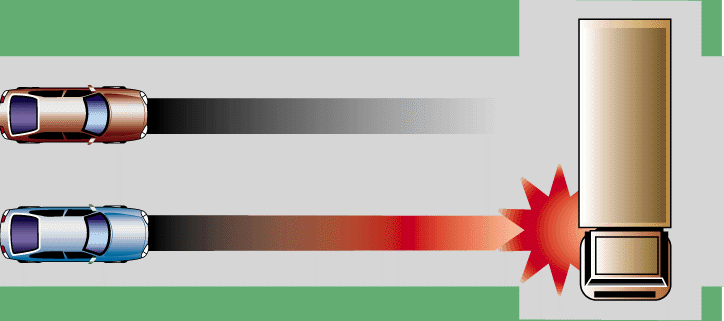
Many drivers, drive in a false belief that if the car in front suddenly started braking, they would react and brake and end up stopped the same distance apart.
The total stopping distance of a vehicle is made up of 4 components.
- Human Perception Time
- Human Reaction Time
- Vehicle Reaction Time
- Vehicle Braking Capability
The human perception time; is how long the driver takes to see the hazard, and the brain realize it is a hazard requiring an immediate reaction. This perception time can be as long as ¼ to ½ a second.
Once the brain realizes danger, the human reaction time is how long the body takes to move the foot from accelerator to brake pedal. Again this reaction time can vary from ¼ - ¾ of a second.
These first 2 components of stopping distance are human factors and as such can be effected by tiredness, alcohol, fatigue and concentration levels. A perception and reaction time of 3 or 4 seconds is possible. 4 seconds at 100 km/hr means the car travels 110 metres before the brakes are applied.
Once the brake pedal is applied there is the vehicles reaction time which depends on the brake pedal free-play, hydraulic properties of the brake fluid and working order of the braking system.
This is why the tailgating car usually cannot stop, when the brake light came on in the car in front, this driver had already completed the perception, human and vehicle reaction periods. The following driver was perhaps 1 second to late in applying the brakes. At 100km/hr the car required 28 metres further to stop.
The last factor than determines the total stopping distance is the cars braking capability which depends on factors such as;
- the type of braking system,
- brake pad material,
- brake alignment,
- tyre pressures,
- tyre tread and grip,
- vehicle weight,
- suspension system,
- the co-efficient of friction of the road surface,
- wind speed,
- slope of road,
- surface smoothness
- the braking technique applied by the driver.
Worth noting is that from 50 to 100 kph the braking distance of a car will increase from 10 metres to 40 metres. When you double the speed of a car braking distance quadruples.
This is based on the laws of physics. When a car is moving it has kinetic energy, ½mv2. When the velocity doubles the kinetic energy quadruples. The braking capability does not increase when driving faster, there are no reserves of friction. As such in any vehicle when your speed doubles braking distance is four times larger.
BRAKING DISTANCE FROM 100 km/hr (real world testing)
The table below lists the BRAKING DISTANCE of various cars from 100 km/h. These cars were tested at different locations on different days.
Be careful comparing results as test results can vary depending on many factors including the road surface, how the speed was measured (as various cars have differing speedometer accuracies), the tyre pressures, fuel load and whether the car had only the driver or had additional passengers.
MAKE/MODEL DISTANCE (m) SOURCE Alfa MITO 37.61 Motor Magazine (Aust) Alfa Giulietta QV 37.80 Motor Magazine (Aust) Audi A5 Sportsback 37.62 Motor Magazine (Aust) BMW 123D Hatch 37.95 Motor Magazine (Aust) BMW 330D Coupe 36.63 Motor Magazine (Aust) Chrysler 300C 38.72 Motor Magazine (Aust) Holden VE Commodore SV6 39.86 Motor Magazine (Aust) HSV GXP 37.76 Motor Magazine (Aust) HSV GTS (WP tuned - 2011) 38.31 Motor Magazine (Aust) Nissan GTR (R35 - 2011) 32.75 Motor Magazine (Aust) Porsche 911 Turbo S (2011) 39.62 Motor Magazine (Aust) Renault Megane RS250 36.34 Motor Magazine (Aust) Renault RS Clio 200 36.43 Motor Magazine (Aust) Subaru Impreza WRX 37.38 Motor Magazine (Aust) Suzuki Alto 43.56 Motor Magazine (Aust) W Golf GTD 37.58 Motor Magazine (Aust) VW Golf R 39.57 Motor Magazine (Aust) VW Golf GTI 39.36 Motor Magazine (Aust) Volvo C30 TS 39.05 Motor Magazine (Aust) BRAKING & STOPPING DISTANCE CHART (government data)
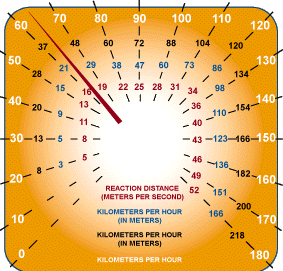
This is a chart issued by a transport department. It shows reaction distance, braking distance and total stopping distance in a convenient diagram. However the devil is most definetly in detail.
This diagram suggests 60 metres of braking distance will be required by a car at 100 km/h. Resulting in a total stopping distance of 88 metres. There are many of these diagrams issued around the world and most tend to have a total stopping distance at 100 km/h within the range of 80 metres to 94 metres.
Real world testing data (see above table) suggests a modern car only requires a braking distance of less than 40 metres.
Now it is conceded that "worst-case scenarios" need to be considered as we all don't drive sportscars. However I suggest many government diagrams are at best "out-of-date" and at worst "exaggerated". Keep in mind any exaggeration is magnified in the government charts as the speeds increase.
(Written by Joel Neilsen, Managing Director, Safe Drive Training)