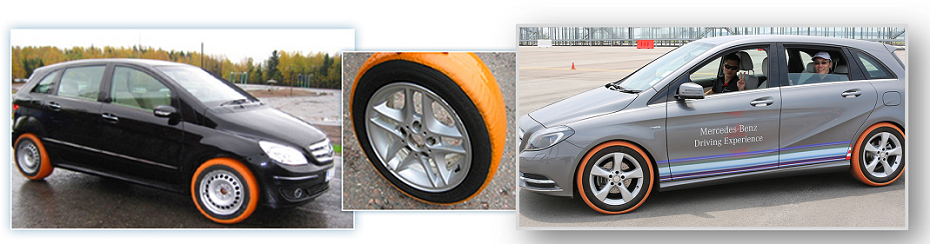
A revolutionary driver training aid has been launched in Australia by one of the country's leading driver education organizations enabling drivers to be trained in dangerous low traction situations without the need for a skid pan or skid frame.
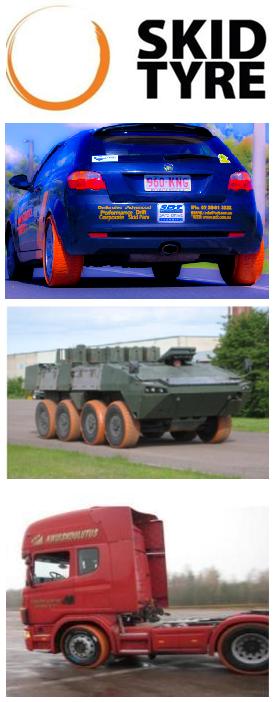
Skid Tyres are a Scandinavian invention that involves applying a special patented plastic low friction contact surface to normal road tyres reducing the co-efficient of grip enabling drivers to understand how a car will react in a low traction situation and be taught how to anticipate and control the situation.
The vehicle is stable at speeds up to 30km/h but at speeds above this the tyre breaks traction providing the perfect driver training scenario at low overall speeds.
According to distributor for Skid Tyres in Australia and New Zealand, Joel Neilsen of Safe Drive Training the new driver aid allows users the convenience of conducting skid control training on any sealed surface including airport runways and taxiways, closed roads or car parks and at drag strips and race circuits without the need for purpose built skid pans water additives or expensive skid frames.
"It will revolutionise driver training particularly when it comes to teaching drivers how to cope with wet and slippery road conditions including snow and ice which many Australian driers struggle with," said Joel Neilsen.
"In he past this sort of driver training has been very limited due to availability and cost of skid pans or skid frames, now for just a few hundred dollars we can give drivers the experience and training need to learn car control in marginal conditions,' he added.
"The other bonus is that the Skid Tyres low-friction contact surface can be added to used or worn out tyres that would in the past have been thrown out," he said.
"You can teach drivers how to control understeer by putting the Skid Steer tyres on the front wheels of the training car or oversteer technique by fitting them to the rear of the car, it is very simple and extremely versatile," said Mr. Neilsen.
"The Skid Tyres offer may advantages including the accuracy of the simulation of low grip conditions, easy of portability and use, very low noise emissions and the use of normal cars but most importantly they do not require fast or aggressive driving to replicate slippery conditions," he said. |